Chat for Hope: Cultivating mental health among Ukrainian youth

From air raid alarms to high school crushes, Ukrainian youth are balancing everyday adolescence with the trauma of war. Professor Shufang Sun is working to address their vast unmet psychological needs with a tech-based approach that delivers crucial support to teenagers navigating life amid conflict.

Shufang Sun, associate professor of behavioral and social sciences, and of psychiatry and human behavior at Brown, has lived in the world of mental healthcare her entire life. Her mother was a psychiatric nurse in one of the first psychiatric hospitals in China. The hospital provided housing to her family and Shufang regularly played in the park where patients took their daily walks. Because of this, Shufang didn’t grow up with the stigma that a lot of us attach to mental healthcare. Instead, she was fascinated by it. And those early experiences have informed her own interests in mental health and global mental health in particular.

Today, Shufang is a licensed psychologist and a professor who runs the Global Mental Health and Flourishing Lab at Brown, where she researches how trauma, structural oppression and conflict affect the mental health of young people all over the world. Her latest project involves kids living in Ukraine, where Russia’s war has taken a major toll on the mental health of adolescents. 

A recent study of Ukrainians between the ages of fifteen and eighteen, found a third had moderate to severe depression, and a third had PTSD. Another study in war-affected regions found almost 40% of girls, ages 11 to 17, had experienced suicidal ideation.

For the October episode of Humans in Public Health, Megan Hall spoke with Professor Sun about the psychological toll of the war, the struggles Ukrainian children face and how Sun and her colleagues are working to address them. 

LISTEN TO THE FULL CONVERSATION

It's been more than four years since the Russian invasion—that means a 16-year-old in Ukraine has been living with war since they were 12. What is life like for teenagers in Ukraine today?

Sun: You wake up, go to school, and you go home like all other teens. You do your homework, and you might be worried about a crush. And then at 2:00 AM, an alarm on your phone wakes you up because of an air raid. And you quickly find shelter, or maybe you go to a metro. You stay there till 4:00 AM, you go home, you check your phone to see if school's still on today or if it’s online.

If the school is on, you go and, hopefully, navigate the city safely. In the meantime, you are thinking about college, planning your future. 

It's almost like two realities. There is sort of the normal teen stuff, and then the other reality is one of war and how families are separated and how it's hard to plan a future when you don't know what that future would look like.

So, there are several challenges. One is the constant stress and threat to safety. Another is simply the scale of mental health problems that go beyond what specialists can address.

Because there just aren't enough specialists there, or they can't reach them because of the war conditions?

Both. In the whole country of Ukraine, there are around 13,000 school psychologists. And from the data that we have from our collaborators in Ukraine, from 2023 to 2024, there were around 4.8 million calls for help. There are just simply not enough specialists to support the need, population-wise.
It's almost like two realities. There is sort of the normal teen stuff, and then the other reality is one of war and how families are separated and how it's hard to plan a future when you don't know what that future would look like.

Shufang Sun Ph.D. associate professor of behavioral and social sciences and of psychiatry and human behavior
 
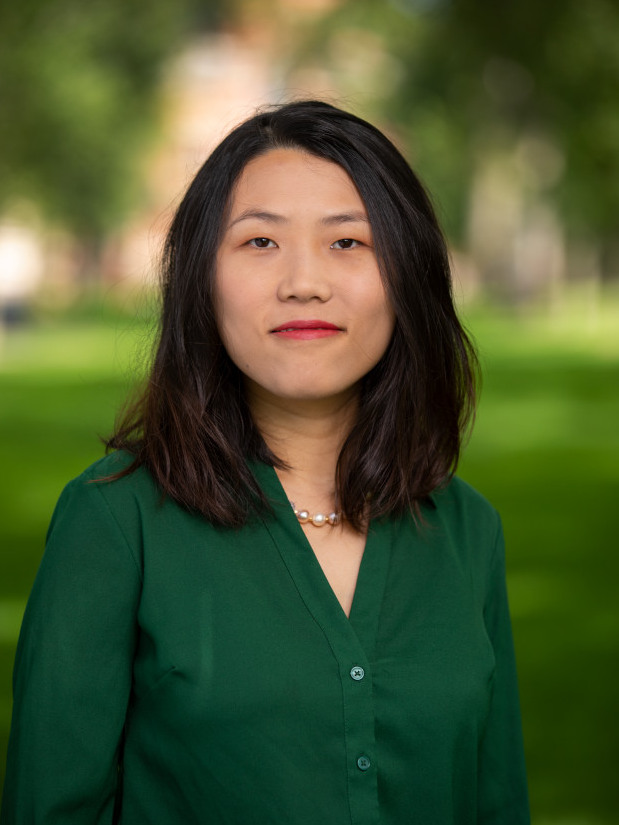
Headshot of Professor Shufang Sun.

Tell us about your project Chat for Hope, which uses a smartphone app to screen and treat young adults for mental health conditions. 

The question that we're asking is: How can we close the treatment gap in a way that doesn't replace human care, but also provides adolescents what they might need? The app lets young people share what they're experiencing and then they can be connected to treatment and skills tailored specifically to their mental health needs. That can include mindfulness and communication skills, the reduction of the stigma around mental health and the willingness to seek help.

How will kids interact with the app? Will it be the kind of open-ended AI-powered chatbot that we’re hearing about lately?

For participants in the program, what they encounter is all already thoughtfully developed, culturally tailored content. It's not ChatGPT style: it’s deterministic and decision-tree-based.

Let's say I'm a 14-year-old in Ukraine, and I'm experiencing anxiety and depression. What would my experience be?

You would download the app, and from there you would choose your own avatar in terms of what your guide would look like. And then you will have a back-and-forth with an avatar, related to: "Let's check in about how you have been feeling lately. Tell me about the past two weeks."

Based on those answers, we would know the level of depression or anxiety that you feel. And if you pass a certain threshold, based on those symptoms, the treatment program can be tailored to you. All of the responses kids will receive through their avatar will be written ahead of time by my colleagues and myself.

For example, if you have traumatic stress, there's specific content related to understanding how trauma works and the impact of trauma on the body. Then there’s guidance on how to self-regulate emotions and also understanding how the nervous system works. This would be followed by simple somatic exercises that you can do to help regulate the nervous system. 

There's definitely trade-offs with the generative AI versus this type of style that is predetermined, but still can be relatively tailored based on what we know about your symptoms and your level of your exposure to the war.

For generative AI, it can feel more exciting for adolescents because you don't know what the program will say. And for that reason, it can also be a little addictive. It's also unpredictable and unsafe from a research standpoint because we don't know if the AI model might say dangerous things to adolescents.

After more than two years of planning, you’ve received funding and are preparing to travel to Ukraine. Tell us about this upcoming journey.

We just had our project launch meeting with our Ukrainian partners: the National Academy of Education Sciences of Ukraine and the Institute of AI Problems for Ukraine. It just feels a very important part of the work to actually be there. You know, we can't just make decisions sitting here in Providence. That's not how it works. It's a collaboration, and the bidirectional exchange of knowledge is a very important part of it.

Where are you in the research phase so far?

It will be a few years before the app is in the hands of Ukrainian children. I hope the war ends tomorrow. But when the war ends, the work doesn't end. The recovery of the nation for Ukraine is only going to be starting at that point.

I mean, we are now in the fifth year of war, so we already have a generation of young people whose formative years have been spent during wartime. So regardless of when the war will end, and I do hope it ends soon, the impact of war cannot be undone and the work is only starting.

If your project is successful, what will that look like?

There's several ways. One is that it works in quantitative terms and we see a reduction in depression, anxiety and PTSD symptoms right after treatment, as well as after three to four months during follow-up, compared to people who did not receive this program. 

It would also be sustainable in terms of funding. What often happens in research is that the intervention works, and then once funding runs out, all of the resources are also gone. And a lot of that is shaped fundamentally by how incentives work. For academics, the incentives are often grants and papers, with faculty often on a treadmill chasing the next grant and next thing. But this is unfair to the local communities. 

So we're quite intentional in thinking in terms of “What would sustainability look like?” It could look like a bigger grant for another five years. But we're also interested in working with policymakers in Ukraine, thinking about policy guidelines for this work that make mental health screening more routine and continually available for adolescents, along with continuing education for school counselors.